Quick Answer
HBOT means breathing oxygen under pressure, which floods your bloodstream with far more oxygen than normal breathing can deliver. That oxygen reaches the muscles you just worked and may help them repair faster. The research is encouraging: a 2025 review of 10 studies found HBOT accelerated recovery from exercise-related muscle damage.1 It works best as part of a real recovery routine, not a one-and-done. Want to feel the difference? A first 30-minute session is $49 for new clients.
If you train hard, HBOT is one of the most interesting recovery tools you can try. You breathe pure oxygen inside a pressurized chamber, and that pressure drives far more oxygen into your blood and into the muscles you just worked. Pro athletes use it. Serious lifters and runners use it. And the research is starting to explain why.
A 2025 review of 10 studies found HBOT sped up recovery from the muscle damage hard training causes.1 It is not an instant fix, and we will be straight with you about where the science is still thin. But if you want to recover faster and feel better between sessions, it is worth trying, and a first 30-minute session at Defiant in Lisle is $49.
What HBOT Is
At its core, HBOT is straightforward. You breathe oxygen inside a sealed chamber that is pressurized above normal air pressure.
The air you breathe every day is about 21 percent oxygen at normal pressure. Inside the chamber, the pressure rises, often to between one and a half and two times normal, so your lungs take in far more oxygen than they could in an ordinary room.
The mechanism is physical. Normally your red blood cells carry most of your oxygen. Under pressure, a meaningful amount also dissolves directly into the liquid part of your blood.4 That raises how much oxygen reaches your muscles and tissues. The rationale for recovery is that more available oxygen may help your body repair tissue and clear the byproducts of hard exercise.
Doctors have used HBOT for specific medical conditions for decades. Using it for athletic recovery is much newer, and that newer use is what this post is about.
How HBOT May Support Recovery
It comes down to oxygen and inflammation.
Hard training tears up muscle on a microscopic level and kicks off inflammation, and for a while your muscles want more oxygen than your body easily delivers. HBOT is meant to close that gap. More available oxygen may calm inflammation, feed worked muscle, and support the cells that rebuild it.1
For an athlete, the real question is blunt: can it get me back to full speed faster? Full recovery after a hard competition can take up to three days, which is rough when your next session or game is tomorrow.2 HBOT is being studied as a way to shrink that window. Research suggests it may help. How much comes down to you, the protocol, and how often you go.
What the Research Actually Shows
Here is the real talk: the evidence is encouraging and growing, and it is not airtight yet. Both things are true.
Start with the best evidence. A 2025 review pooled 10 studies and 299 people and found HBOT significantly sped recovery from exercise-related muscle damage.1 That is pooled, controlled data, not a testimonial from someone with a sponsorship.
Soreness is where it gets honest. That same review did not find a clear soreness benefit overall, only when sessions ran longer or at higher pressure.1 A 2024 trial ran young soccer players through a single session after a match and found they felt less tired an hour later, even though their bloodwork barely moved.2 Read that as a clue: HBOT seems to reward a routine, not a one-time visit. And an older study found no effect on next-day soreness at all.3
So no, the science is not finished, and anyone promising guaranteed results is overselling. But the direction is positive, the mechanism makes sense, and the people who get the most out of HBOT treat it as a regular part of recovery, not a rescue after they have already overdone it.
| What the research suggests | What it does not show |
|---|---|
| Faster recovery from exercise-related muscle damage1 | Guaranteed results for everyone, or for every type of soreness |
| A mechanism that makes sense: more oxygen reaching tissue14 | One settled “right” pressure and dose |
| The most upside when it is a regular habit2 | A substitute for sleep, nutrition, and smart training |
Bottom line: the research is promising, the logic holds up, and HBOT earns its place in a recovery routine. Go in expecting a helpful edge, not a one-shot fix.
What HBOT Is Not Cleared to Treat
Quick but important: HBOT has a serious medical side, and recovery is not it.
The FDA has cleared hyperbaric chambers to treat a specific list of conditions, including decompression sickness, carbon monoxide poisoning, certain non-healing wounds, and diabetic foot ulcers.4 Athletic recovery and general wellness are not on that list, and the FDA has openly cautioned consumers about clinics that claim otherwise.4
So we will say it plainly. We offer HBOT for recovery support. We tell you what the research suggests it may do, we link the studies, and we never pretend it treats a disease or replaces your doctor. If you are dealing with a real medical condition, that is a conversation for a physician, not a recovery session.
Who Tries HBOT for Recovery
Two kinds of people end up in the chamber.
The first trains hard and often: the marathoner, the lifter, the league player who wants to wake up tomorrow feeling less beat up. The recovery research speaks straight to them.1 If that is you, our companion piece on HBOT for athletes and injury recovery goes deeper on the sports side.
The second just has a demanding life. A tough job, training on the side, and a body that does not bounce back the way it did at 25. A lot of them stack HBOT with other recovery tools, sliding it in next to cryotherapy for cold and infrared and dry heat sauna sessions, and build a real recovery day around it.
One honest caveat: HBOT is not for everyone. Certain ear and lung conditions rule it out, so we run a quick screening before your first session. It takes a minute and keeps you safe.
What an HBOT Session Feels Like
It is a lot calmer than the gear suggests.
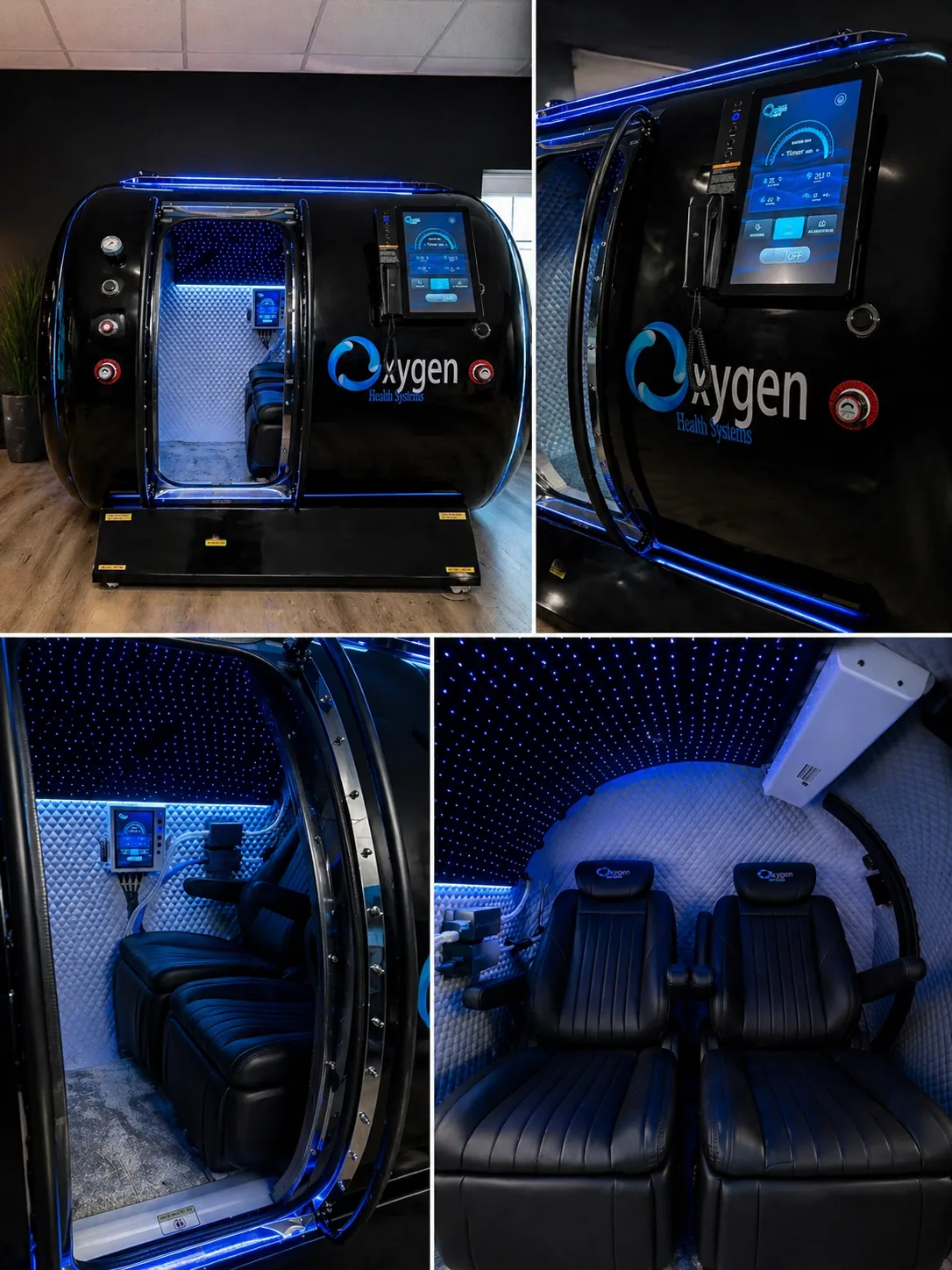
At Defiant you settle into an OxyHealth hard-shell chamber that seats two and runs up to 2.0 ATA, about twice normal air pressure. It pressurizes slowly while you sit or recline. The one thing you will actually feel is your ears, the same pop as a plane taking off, and a yawn or a swallow clears it. After that, you just breathe. Most people read, put on a podcast, or close their eyes.
Sessions run 30, 60, or 90 minutes. Which one is right depends on your goals and how you respond, so it is worth talking through before you commit to a longer block.
How Defiant Does HBOT in Lisle
Defiant runs hyperbaric oxygen therapy at 5100 Lincoln Ave in Lisle, an easy drive from Naperville, Downers Grove, Wheaton, Oak Brook, and the rest of Chicago’s western suburbs.
Pricing is straightforward:
| Session | Price | New client (first 30-min) |
|---|---|---|
| 30 minutes | $99 | $49 |
| 60 minutes | $185 | n/a |
| 90 minutes | $225 | n/a |
The smart way to start is the new-client first 30-minute session for $49. If recovery is a regular thing for you, HBOT is also built into the monthly credits on the Premier and Elite membership tiers.
Building a real recovery routine? HBOT plays well with cold and heat. Our guide to combining sauna and cryotherapy for contrast therapy shows how the pieces fit.
- HBOT is breathing oxygen under pressure, which drives far more of it into your blood and into the muscles you just worked.
- The research is encouraging. A 2025 review of 10 studies and 299 people found HBOT sped recovery from exercise-related muscle damage.
- It is promising, not a sure thing. Soreness results were mixed, an older trial found no effect, and protocols vary, so expect an edge, not a guarantee.
- Recovery is not an FDA-cleared use of HBOT. That is a separate medical list, and HBOT does not replace medical care.
- It works best as a habit, not a rescue. Stack it with cryotherapy, sauna, good sleep, and smart training.
Common Questions
See for Yourself.
Research suggests HBOT may support recovery from hard training. Come try a first 30-minute session for $49 and see how your body responds.
Keep Reading
Last updated June 27, 2026.
References
- Effects of Hyperbaric Oxygen Therapy on Exercise-Induced Muscle Injury and Soreness: A Systematic Review and Meta-analysis. Archives of Physical Medicine and Rehabilitation. 2025. PubMed
- Effects of hyperbaric oxygen therapy on recovery after a football match in young players: a double-blind randomized controlled trial. Frontiers in Physiology. 2024. Frontiers in Physiology
- Webster AL, et al. Effect of hyperbaric oxygen on recovery from exercise-induced muscle damage (delayed onset muscle soreness). 2000. PubMed
- U.S. Food and Drug Administration. Hyperbaric Oxygen Therapy: Get the Facts. FDA