Quick Answer
A longevity stack combines several well-studied tools to support recovery, performance, and healthy aging across multiple body systems at once. The four modalities covered here — hyperbaric oxygen therapy (HBOT), contrast therapy (sauna paired with cryotherapy), IV therapy including NAD+, and peptide therapy — each target a different layer of how the body breaks down and rebuilds. HBOT works on cellular oxygen delivery and inflammation. Contrast therapy works on the autonomic nervous system and recovery. IV and NAD+ work on cellular energy. Peptides work on signaling and repair. The point isn’t any single tool; it’s the combination, used consistently.
A longevity stack is a coordinated set of interventions used together to support recovery, performance, and healthy aging. The idea isn't that any single tool transforms you. The idea is that several well-chosen tools, used consistently and in the right combinations, address different parts of how the body breaks down and rebuilds over time.
We're walking through four of the most-studied modalities in the longevity space: hyperbaric oxygen therapy (HBOT), contrast therapy (sauna paired with cryotherapy), IV therapy including NAD+, and peptide therapy. For each one, we'll cover what it is, what the research shows, and where it fits in a broader stack.
The Concept of Stacking
Before getting into specific tools, it helps to understand what stacking actually means.
Your body operates as a series of overlapping systems. Cardiovascular, metabolic, musculoskeletal, nervous, immune. When any one of these is under stress, the others compensate. Over time, accumulated stress in one system shows up as dysfunction in another. Poor sleep affects glucose regulation. Chronic inflammation affects mood. Sedentary behavior affects mitochondrial function.
A stack works by addressing multiple systems at once, rather than chasing a single output. HBOT works on cellular oxygen delivery and inflammation. Contrast therapy works on the autonomic nervous system and recovery. IV therapy and NAD+ work on cellular energy and substrate availability. Peptides work on signaling and repair.
None of these tools is a replacement for the basics: sleep, nutrition, movement, sunlight, and social connection. The basics do the heavy lifting. A stack is what you layer on top once the foundation is in place.
Hyperbaric Oxygen Therapy (HBOT)
HBOT involves breathing oxygen at higher than atmospheric pressure inside a sealed chamber. The pressure is typically expressed in ATA, or atmospheres absolute. Most longevity protocols run at 1.5 to 2.0 ATA, which is roughly equivalent to being 15 to 30 feet underwater.
How it works
Under normal atmospheric conditions, your red blood cells carry most of the oxygen in your blood. When you increase atmospheric pressure and breathe pure or near-pure oxygen, you can dissolve significantly more oxygen directly into the plasma, the liquid portion of your blood. That dissolved oxygen reaches tissues that don't get enough under normal conditions, including tissues that don't get much blood flow like tendons, ligaments, and certain regions of the brain.[1]
What the research has examined
HBOT is FDA-approved for around 13 specific medical conditions, including decompression sickness, carbon monoxide poisoning, and certain non-healing wounds. Outside those approved uses, research has examined effects on inflammation, cognitive recovery after concussion, athletic recovery, and aging-related markers. A 2020 study published in Aging showed measurable changes in telomere length and immune cell senescence markers in older adults following a 60-session HBOT protocol.[2]
Where it fits in a stack
HBOT is most relevant for people focused on recovery from injury, post-surgical healing, cognitive function, or general inflammation reduction. Sessions typically run 60 to 90 minutes. The research suggests effects build with consistency rather than appearing after a single session. For more, see our explainer on what HBOT is and how athletes use it for recovery.
Contrast Therapy: Sauna Paired with Cryotherapy
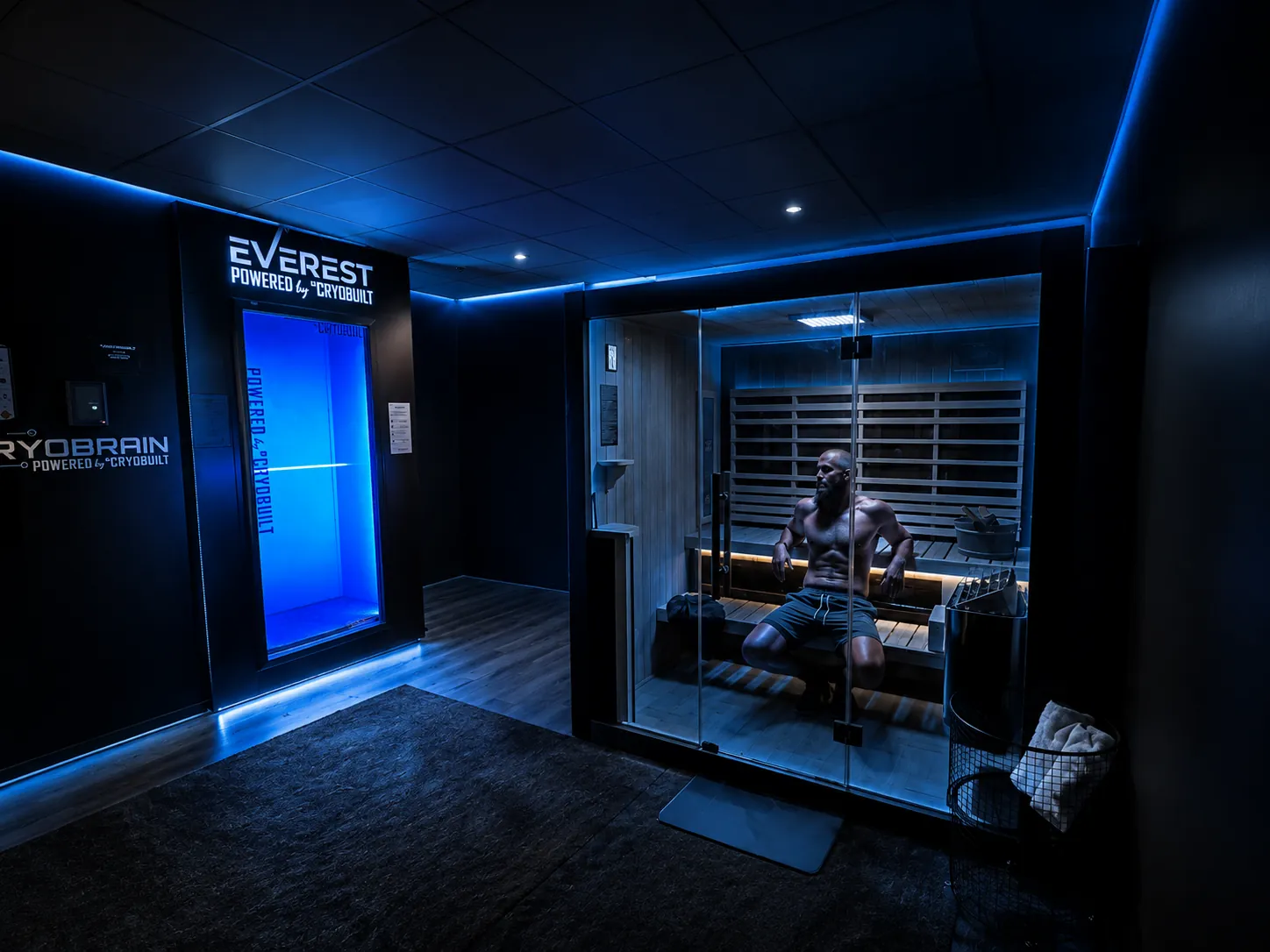
Contrast therapy means deliberately exposing the body to both extreme heat and extreme cold, usually in sequence. At its simplest, this looks like an infrared sauna session followed by a cold exposure session. The contrast itself is the point.
How heat works
When you sit in a sauna at 150 to 200 degrees Fahrenheit, your core temperature rises, your heart rate increases, and your blood vessels dilate to dump heat. Your body responds with a cascade of effects: increased heat shock protein production, improved cardiovascular function, and a temporary boost in growth hormone in some protocols. Long-term sauna use has been associated in observational studies with reductions in cardiovascular mortality and dementia risk, with the largest effects seen at four to seven sessions per week.[3]
How cold works
Cold exposure, whether cryotherapy or cold water immersion, triggers vasoconstriction (blood vessels narrowing), a sharp release of norepinephrine, and activation of brown adipose tissue. Norepinephrine is a neurotransmitter and hormone involved in focus, mood, and metabolic regulation. Cold exposure has been shown to elevate norepinephrine substantially, with effects lasting for hours after a session.[4] This is the mechanism behind dedicated cryotherapy in Lisle and Naperville, where a short, controlled cold session delivers the stimulus in a few minutes.
Why combine them
Heat dilates blood vessels. Cold constricts them. Cycling between the two acts as a kind of vascular pump, pushing blood and lymphatic fluid through tissues. Heat triggers one set of recovery and longevity pathways. Cold triggers a different set, including those related to inflammation and stress resilience. Doing both in the same session, the way contrast therapy in Lisle, IL is structured, may engage more of the body's recovery machinery than either alone.
Where it fits in a stack
Contrast therapy is most relevant for people focused on recovery, sleep quality, stress regulation, and metabolic health. Sessions are short and accessible. Protocols vary, but a common approach is 15 to 20 minutes of sauna followed by 2 to 3 minutes of cold exposure, repeated two or three times.
IV Therapy and NAD+
IV therapy delivers vitamins, minerals, amino acids, and other compounds directly into the bloodstream, bypassing the digestive tract. The argument for IV delivery is bioavailability. When you take a vitamin orally, your gut absorbs a fraction of it, your liver processes it, and what reaches your tissues is often a small percentage of the original dose. IV delivery skips those steps.
The most-discussed compound in the longevity IV space is NAD+, or nicotinamide adenine dinucleotide.
What NAD+ actually does
NAD+ is a coenzyme present in every cell in your body. It's involved in two major categories of cellular work: energy production and cellular repair. In energy production, NAD+ shuttles electrons through your mitochondria, which is how cells generate ATP, the molecule that powers everything you do. In repair, NAD+ is a required substrate for enzymes called sirtuins and PARPs, which regulate DNA repair, gene expression, and cellular stress responses.[5]
Why people care about it
NAD+ levels decline with age. By the time most people reach 50, their NAD+ levels are roughly half of what they were in their 20s. Researchers have hypothesized that this decline contributes to age-related changes in energy, metabolism, and cellular resilience. The hypothesis has driven interest in restoring NAD+ through direct IV administration or through oral precursors like NR (nicotinamide riboside) and NMN (nicotinamide mononucleotide).[5]
What the research shows
Animal studies on NAD+ restoration have shown improvements in markers of aging, mitochondrial function, and tissue repair. Human research is earlier and more mixed. Some studies have shown measurable increases in blood NAD+ levels after IV infusion or oral precursor supplementation. Whether those increases translate into clinical benefits like improved energy, cognition, or longevity is still being studied.
Where it fits in a stack
IV therapy in Lisle and Naperville is most relevant for people addressing specific deficiencies, recovery needs, or supporting performance. NAD+ specifically is more of a longevity-targeted intervention. Sessions vary in length, with NAD+ infusions typically running longer than standard vitamin drips.
Peptide Therapy
Peptides are short chains of amino acids that function as signaling molecules in the body. Where vitamins and minerals are substrates, peptides are messengers. They bind to specific receptors and trigger specific responses.
The body produces hundreds of natural peptides. Insulin is one. Oxytocin is another. So is growth hormone-releasing hormone. Peptide therapy involves administering peptides, either naturally occurring or synthetic, to influence specific biological pathways. See our peptide therapy explainer for a deeper introduction.
FDA-approved peptide therapies
Several peptides are approved by the FDA for specific medical uses. Semaglutide and tirzepatide, the GLP-1 medications used for type 2 diabetes and weight management, are both peptides. So are several hormone therapies and immune-modulating drugs. These have been studied in large clinical trials and have well-characterized safety profiles within their approved uses.
Investigational peptides
A larger category of peptides is studied in research settings but is not FDA-approved for clinical use. This includes peptides examined for tissue repair, growth hormone signaling, and recovery support. The evidence base for these peptides is mostly preclinical (animal studies), with limited human data. Regulatory status varies, and several peptides commonly discussed online cannot be legally compounded for patient use in the United States under current FDA guidance. Our BPC-157 article walks through what this looks like for one widely-discussed compound.
Where it fits in a stack
FDA-approved peptide therapies are most relevant for specific clinical indications and are prescribed accordingly. The investigational peptide space is more speculative and requires careful evaluation of both the evidence and the regulatory landscape. Anyone interested in peptide therapy should be working with a qualified medical provider who can distinguish between what's well-studied, what's emerging, and what's not appropriate.
How These Tools Fit Together
The reason these four modalities show up together in longevity discussions is that they target different layers of how the body functions and ages.
HBOT
Targets oxygen delivery and inflammation at the tissue level.
Contrast Therapy
Targets the autonomic nervous system, vascular function, and stress adaptation.
IV Therapy and NAD+
Targets cellular energy and substrate availability.
Peptide Therapy
Targets signaling pathways related to repair, metabolism, and specific clinical needs.
None of these tools replaces the foundation: sleep, nutrition, movement, and stress management. They sit on top of that foundation as additional levers. The right combination depends on the individual, their goals, and what their baseline looks like.
This is where bloodwork and body composition data come in. A stack designed without baseline data is guesswork. A stack designed around real numbers, tracked over time, is the difference between collecting expensive sessions and actually moving the metrics you care about.
The Bottom Line
The longevity space has more noise than signal. The four tools covered here, HBOT, contrast therapy, IV and NAD+, and peptide therapy, are among the most-studied interventions in the category. Each has a defensible mechanism. Each has a body of research, though the depth varies considerably. And each addresses something different.
The smartest way to use them is the same way you'd approach any other meaningful change: start with the basics, get a baseline, layer interventions with intention, and track what's actually changing. Stacking isn't about doing more. It's about doing the right things in the right order.
- A longevity stack addresses multiple body systems at once rather than chasing a single outcome.
- HBOT targets oxygen delivery and inflammation. Contrast therapy targets vascular function and stress adaptation.
- NAD+ IV therapy targets cellular energy. Peptides target signaling and repair pathways.
- None of these tools replaces the foundation — sleep, nutrition, movement, and stress management.
- A stack built around bloodwork and baseline data beats one designed without it.
Common Questions
Build a Stack Around Your Biology.
Start with bloodwork, body composition, and what you’re actually trying to accomplish — not generic recommendations.
Keep Reading
Last updated May 19, 2026.
References
- Thom SR. Hyperbaric oxygen: its mechanisms and efficacy. Plastic and Reconstructive Surgery. 2011;127(Suppl 1):131S-141S.
- Hachmo Y, Hadanny A, Abu Hamed R, et al. Hyperbaric oxygen therapy increases telomere length and decreases immunosenescence in isolated blood cells: a prospective trial. Aging. 2020;12(22):22445-22456.
- Laukkanen T, Khan H, Zaccardi F, Laukkanen JA. Association between sauna bathing and fatal cardiovascular and all-cause mortality events. JAMA Internal Medicine. 2015;175(4):542-548.
- Šrámek P, Šimečková M, Janský L, et al. Human physiological responses to immersion into water of different temperatures. European Journal of Applied Physiology. 2000;81(5):436-442.
- Rajman L, Chwalek K, Sinclair DA. Therapeutic Potential of NAD-Boosting Molecules: The In Vivo Evidence. Cell Metabolism. 2018;27(3):529-547.